



The leaf behind the name
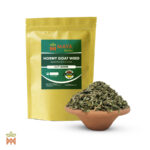
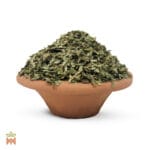
Few herbs have a common name as memorable as Horny Goat Weed. It points to a long-standing Chinese association between Epimedium and sexual vitality, but the plant itself is a delicate woodland perennial with intricate flowers and divided leaves. Maya offers its cut leaves from China, a form closely connected with the plant material described in Chinese herbal literature.
A Chinese woodland perennial
The botanical name used in modern floras is Epimedium brevicornu; E. brevicornum is a spelling still widely encountered in herbal trade and research. It belongs to the barberry family, Berberidaceae, and grows from a creeping underground rhizome. The leaves usually divide into nine leaflets with heart-shaped bases and small, pointed teeth along their margins.
The flowers have conspicuous pale inner sepals and much smaller petals with short, blunt spurs. These details distinguish this species from the many other ornamental and medicinal Epimedium plants. “Horny Goat Weed” and the Chinese herbal name yin yang huo can refer to several species; the name on this listing identifies the botanical being offered.
Desire, strength and Chinese herbal tradition
The herb appears in the early Chinese materia-medica tradition. An old explanation attributed to the physician and naturalist Tao Hongjing (456–536) describes goats becoming sexually active after eating the leaves. This is part of the plant’s recorded naming tradition, rather than evidence of an effect in people.
In traditional Chinese medicine, yin yang huo is described as warming and as a herb that replenishes kidney yang. Within that medical framework, it has been used for sexual weakness and for weakness or discomfort in the lower back and knees. Practitioners also associate it with strengthening the sinews and bones and dispelling “wind-damp”, a traditional explanation for certain patterns of pain and stiffness.
These terms belong to a particular understanding of the body. “Kidney yang” is not a diagnosis of kidney disease or a measurement of testosterone.
Icariin and the limits of laboratory evidence
One of the best-studied constituents of Epimedium is icariin, a flavonoid. Laboratory researchers have examined its interaction with phosphodiesterase-5, or PDE5, an enzyme involved in cell signalling and blood-vessel responses. A 2008 study tested plant extracts, icariin and chemically modified derivatives against the human enzyme.
“Human enzyme” does not mean that the study was a trial in people. Isolated compounds and modified derivatives also differ from unstandardised cut leaves. Such research helps explain scientific interest in the plant, but it cannot establish that these leaves treat erectile dysfunction or reproduce the effects of a medicine.
These Chinese cut leaves are part of our Well-being collection.
Selected references
- Flora of China — Epimedium brevicornu: botanical description
- Hong Kong Baptist University — Yin Yang Huo in the Chinese Medicine Specimen Database
- Di Lu (2017), UCL doctoral thesis, p. 77 — Epimedium in early materia medica and Tao Hongjing’s account
- Dell’Agli et al. (2008) — icariin derivatives in an enzyme assay
This product is sold as a botanical specimen. Information on traditional, cultural and reported uses is provided for educational and ethnobotanical purposes only and is not a recommendation for any particular use. This product is not intended to diagnose, treat, cure or prevent any disease.
Reviews
There are no reviews yet.