


The South African lion’s tail
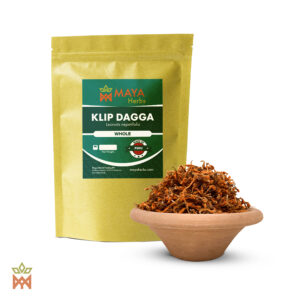
Orange flowers arranged in rising tiers give Wild Dagga its English name, lion’s tail. Leonotis leonurus is a South African shrub whose leaves and flowers have a recorded history of use for their psychoactive character. This product is the finely cut floral material from South Africa.
Traditional use and reported effects
The South African National Biodiversity Institute records the historical use of dried leaves and flowers among Khoikhoi people. Accounts describe calming sensations and mild euphoria. Other reports include dizziness, nausea and changes in vision, a reminder that a reputation for mildness does not make a plant’s effects uniformly pleasant or predictable.
From traditional accounts to experimental research
Researchers have identified numerous diterpenoids in Leonotis leonurus. A 2012 study isolated compounds called leonurenones and questioned a common online explanation that attributes the plant’s reputed effects to leonurine: that alkaloid had not been established in the material discussed.
More recent work has investigated the chemistry produced when the aerial parts are burned. In 2024, Nsuala and colleagues collected the smoke constituents and tested the resulting extract and isolated compounds in zebrafish larvae. They reported activity in experimental models of anxiety and seizure-like behaviour, including effects associated with compounds named leoleorin A and B.
This is a specific experimental link between the traditional mode of use and chemistry. It is not a human clinical result, evidence that smoke is safe, or a finding for an infusion of these cut flowers.
The plant belongs to the mint family, Lamiaceae. Its tubular flowers have hairy outer surfaces and supply nectar to visiting wildlife. Klip Dagga petals come from the related Leonotis nepetifolia; the two species have separate botanical and research records.
Explore our Dream Herbs collection for related botanicals and their individual traditions.

Reviews
There are no reviews yet.