


Butterfly pea and its remarkable blue
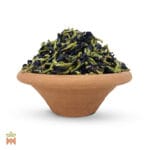
Blue Pea is a flower whose colour has become part of the everyday visual language of Southeast Asia. Known as butterfly pea, Asian pigeon-wings and anchan in Thailand, Clitoria ternatea has broad petals with an intense blue colour and a pale centre. These whole flowers come from Thailand.
A tropical climber
Butterfly pea is a perennial member of the pea family, Fabaceae. Slender stems twine around supporting plants, fences and trellises; the leaves are divided into five or seven leaflets. The flowers develop into long, flattened seed pods, revealing the relationship with other legumes.
The genus name Clitoria comes from the flower’s resemblance to the clitoris. The second part of the name, ternatea, refers to Ternate, an island in Indonesia’s Maluku archipelago.
The species has been cultivated and naturalised so widely that accounts differ on its original range. Its presence throughout the tropics is better established than a simple claim that it originated in Thailand. Thai origin here describes the flowers supplied, while Clitoria ternatea is a plant shared by many tropical landscapes.
Anchan in Thai household traditions
The flowers are well known in Southeast Asian food-colouring traditions. A 2025 study of home gardens in Kham Toei, northeastern Thailand, recorded their use to colour rice, desserts and drinks. In these gardens, the plant was valued for its flowers as well as its practical household uses.
The researchers also recorded beliefs about the fresh flowers and eyesight, alongside their use in hair preparations intended to encourage growth and deepen colour. These accounts describe what local people used the plant for and why they valued it. They concern particular fresh-flower preparations and traditional expectations, rather than demonstrated effects of dried flowers.
Why blue becomes violet
The distinctive blue comes from ternatins, a group of anthocyanin pigments. Anthocyanins also colour many red and purple fruits, but the arrangement of the molecules in butterfly pea helps maintain an unusually vivid blue under suitable conditions.
The pigments respond to acidity. As pH falls, their molecular forms change and the visible colour moves towards violet or pink. This is the chemistry behind the flower’s familiar colour-changing reputation. Research on flower extracts has examined both that shift and the effects of temperature and storage on colour stability.
The same experiments often measure antioxidant activity, meaning how an extract behaves in a particular laboratory test. A strong result in such a test does not by itself show that a flower improves memory, treats anxiety or protects human health.
What the human research studied
A small 2018 crossover study gave 15 healthy men drinks containing a prepared flower extract, with or without sugar. It measured short-term changes in glucose, insulin and antioxidant markers over three hours. The results are preliminary evidence about those study preparations, not proof of lasting health benefits or treatment effects from whole flowers.
Butterfly pea’s most distinctive story remains visible in the flower itself: a tropical climber whose blue pigments connect botanical chemistry with the household traditions of Southeast Asia. It forms part of our Well-being botanical collection.
Selected references
- Plant Resources of South-East Asia — Clitoria ternatea botany and names
- Singapore National Parks Board — the meaning of Clitoria and ternatea
- Saensouk and colleagues (2025) — household plant traditions in northeastern Thailand
- Fu and colleagues (2021) — flower pigments, acidity and colour stability
- Chusak and colleagues (2018) — small human study of a prepared flower extract
This product is sold as a botanical specimen. Information on traditional, cultural and reported uses is provided for educational and ethnobotanical purposes only and is not a recommendation for any particular use. This product is not intended to diagnose, treat, cure or prevent any disease.

Reviews
There are no reviews yet.