
Reishi mushroom powder for steady daily wellbeing
Reishi mushroom powder comes from the mushroom of Ganoderma lucidum, also known in China as Ling Zhi. This earthy, naturally bitter mushroom is one of the most respected botanicals in East Asian herbal traditions, where it is valued for balance, calm presence, resilience and long-term wellbeing.
Reishi is not a psychedelic mushroom. It is traditionally used as a slow, grounding ally rather than something taken for a quick effect. Many people add it to a daily ritual for gentle vitality, inner steadiness and a deeper connection to natural rhythms.
Modern research continues to explore reishi mushroom benefits with measured interest. Reviews describe Ganoderma lucidum as a source of naturally occurring polysaccharides, triterpenes and other bio-compounds, while other scientific literature discusses its antioxidant-related compounds. These findings support why Reishi remains so valued, while its traditional role is best understood as support for normal well-being and steady daily balance.
Ling Zhi in Chinese and East Asian herbal tradition
In traditional Chinese herbalism, Ling Zhi has long been associated with vitality, calm and longevity. It was often respected as a mushroom for patient, consistent use, woven into tonics and warm preparations rather than taken as a sharp stimulant.
Its bitter taste is part of its character. In many herbal traditions, bitter plants and mushrooms are appreciated for the way they bring depth to a preparation. Reishi sits well in slow rituals: evening teas, earthy cacao drinks, coffee alternatives and blends with other functional mushroom preparations.
Historical and modern reviews both note the long-standing place of Ganoderma lucidum in traditional East Asian plant knowledge. At MAYA, we share this heritage with respect, without reducing a living tradition to simple claims.
How to prepare reishi mushroom tea
Reishi powder is easy to add to a daily routine. Because the flavour is earthy and bitter, many people prefer it in warm, rich drinks rather than plain cold water.
- Stir a small amount into warm water or herbal tea.
- Use it to make a simple reishi mushroom tea, with honey or warming spices if desired.
- Blend into cacao, chai, coffee alternatives or smoothies.
- Add to mushroom tonics or daily wellbeing drinks.
- For a stronger traditional-style preparation, gently simmer in water and strain if you prefer a smoother drink.
Start with a small amount and adjust slowly to your own taste and routine. Reishi is often appreciated as a steady companion, not as a quick burst of energy. If you enjoy broader mushroom blends, you may also like the 7 Mushrooms Mix.
How to store your Reishi powder
Keep your reishi powder in a cool, dry and dark place. Close the pack well after each use to protect the powder from moisture and strong kitchen smells.
Use a clean, dry spoon each time. This helps preserve the natural aroma, texture and bitter mushroom character of the powder.
Respectful sourcing of Ganoderma Lucidum mushroom
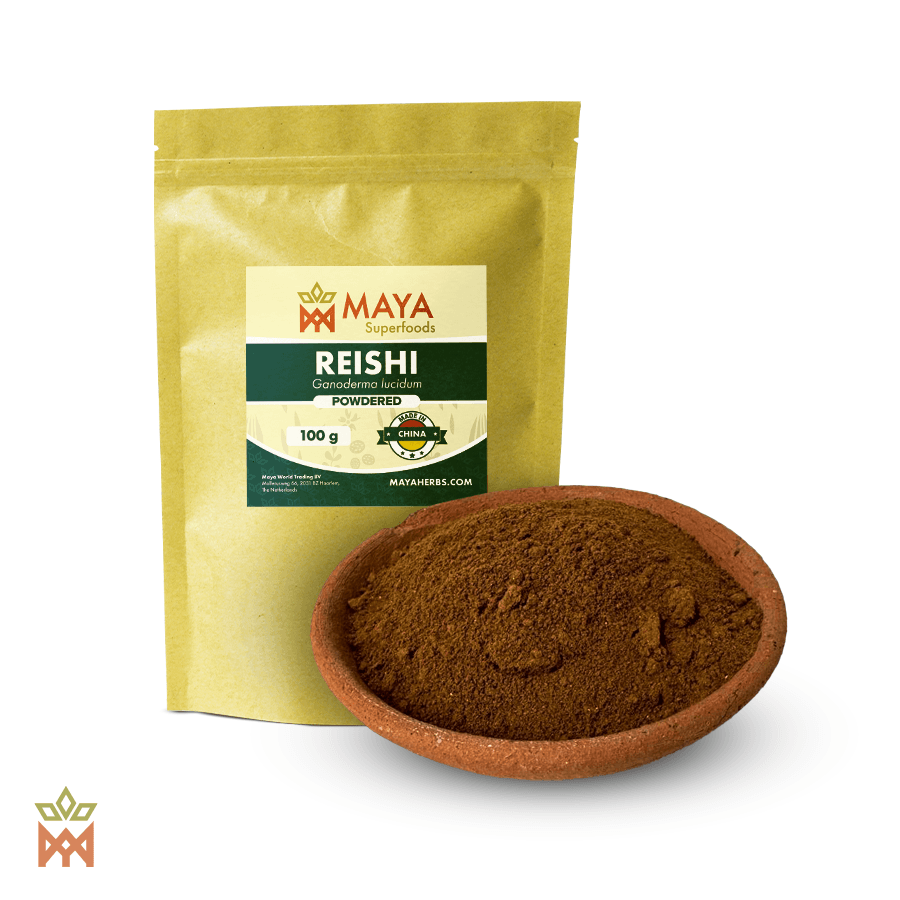
This Reishi powder is listed with China as its country of origin, reflecting the deep relationship between Ling Zhi and Chinese herbal tradition. It is offered in a simple 100 gram powdered form for people who wish to prepare it in their own way.
MAYA Ethnobotanicals works with respect for traditional plant knowledge, careful handling and ethical botanical trade. With culturally important plants and mushrooms like Reishi, we aim to share clear information without exaggeration, and to honour the traditions that kept this knowledge alive.
Further reading on Reishi mushroom and Ganoderma lucidum
- Ganoderma lucidum—From Ancient Remedies to Modern Applications: Chemistry, Benefits, and Safety— by MP Plosca, 2025
Polysaccharides PS-G and Protein LZ-8 from Reishi (Ganoderma lucidum) exhibit diverse functions in regulating murine macrophages and T cells.
pmc.ncbi.nlm.nih.gov - Nutritional Profile and Health Benefits of Ganoderma lucidum “Lingzhi, Reishi, or Mannentake” as Functional Foods: Current Scenario and Future Perspectives — by AF El Sheikha, 2022
The review references a study using lingzhi or reishi Ganoderma lucidum (W. Curt.: Fr.) P. Karst. (Higher Basidiomycetes).
mdpi.com - Natural Bio-Compounds from Ganoderma lucidum and Their Beneficial Biological Actions for Anticancer Application: A Review — by E Cadar, 2023
As a library, NLM provides access to scientific literature, including discussion of free-radical scavenging and mitochondrial antioxidant activities of Reishi-Ganoderma lucidum.
pmc.ncbi.nlm.nih.gov - Reishi Mushroom (Ganoderma lucidum) Standards of Analysis, Quality Control,
and Therapeutics — by Miyahara R, Yoshimoto T, Asawa K, 1987
Chemical structures and changes of extracts during growth of reishi [Ganoderma lucidum]. Mokuzai Gakkaishi 33(5):416.
researchgate.net - Valorization of various lignocellulosic wastes to Ganoderma lucidum (Curtis) P. Karst (Reishi Mushroom) cultivation and their FT-IR assessments — by C Akcay, 2025
Valorization of hazelnut branch pruning wastes to medicinal mushroom (Reishi-Ganoderma lucidum) cultivation and nutritional quality properties.
journals.plos.org - Three Popular Medicinal Mushroom Supplements — by M Frost, 2016
“Reishi (Ganoderma lucidum): 456 Gram (1 Pound) – 16 Ounce – 3 Month Supply.” Accessed September 23, 2015.
scholarsarchive.byu.edu
This product is sold as a botanical specimen. Information provided here is for educational and ethnobotanical purposes only. It is not intended to diagnose any ailment, or to treat, cure, or prevent any disease. Please check your local regulations before ordering botanical products.


Reviews
There are no reviews yet.