
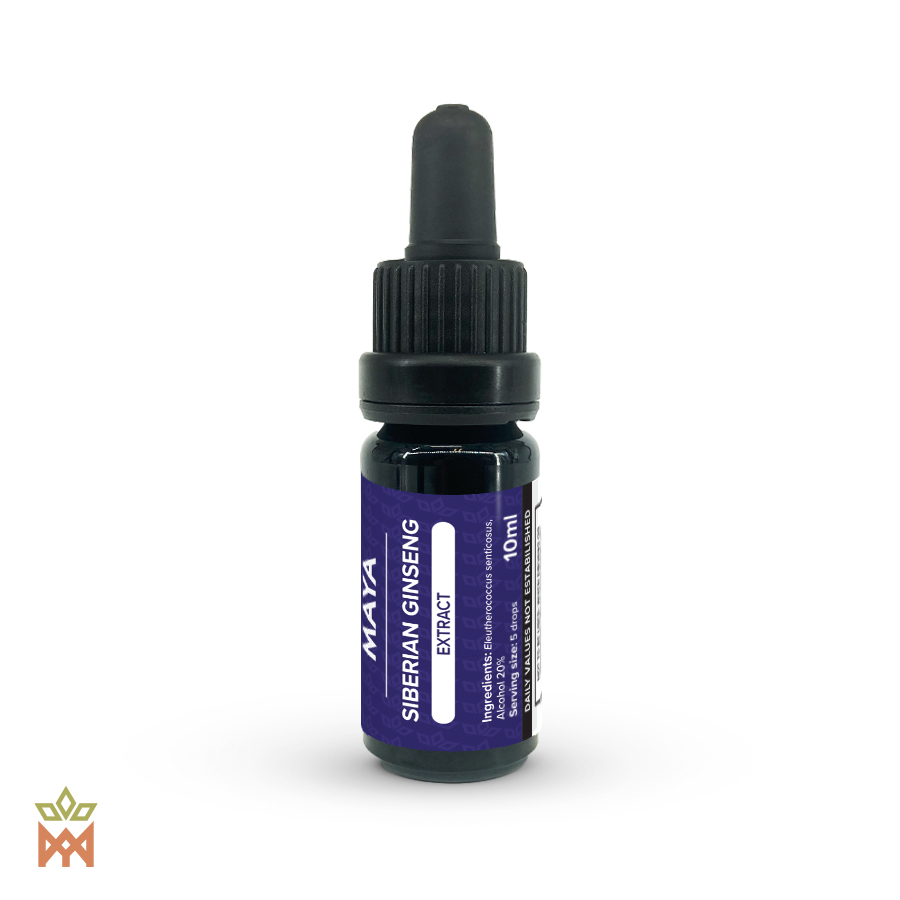

Eleuthero — the plant behind Siberian Ginseng
Siberian Ginseng has a botanical identity of its own. Eleutherococcus senticosus, also called eleuthero or ci wu jia, is a prickly woodland shrub of northeastern Asia. Its root became known internationally through herbal traditions concerning strength and stamina, followed by research into the demands of physical work and stress. This is a liquid extract of the root.
The familiar name can be misleading: eleuthero belongs to the same family as true ginseng, Araliaceae, but to a different genus from Panax. That distinction matters when reading about the plant’s constituents, traditional uses and scientific studies.
A shrub of northeastern Asian woodlands
The species grows across the Russian Far East, China, Korea and Japan. It is a deciduous shrub with slender prickles along its stems and leaves typically divided into five leaflets. Small flowers are gathered into rounded clusters, followed by dark fruits. Mature plants can reach several metres in height.
The root is the part associated with the preparations discussed here. Older literature often uses the botanical name Acanthopanax senticosus; this is a recognised synonym, not a second ingredient.
From traditional tonic to adaptogen research
Under the Chinese name ci wu jia, the plant has been used as a tonic intended to restore vigour and support people experiencing weakness or tiredness. Historical accounts also describe expectations concerning appetite and memory. These uses explain what people sought from the plant, rather than demonstrating an effect of this extract.
Its international reputation expanded during the twentieth century. The European Medicines Agency’s historical assessment records Soviet approval of an eleuthero root extract in 1962 and its subsequent place in research on work capacity and demanding environments. Eleuthero became closely associated with the developing concept of an adaptogen: a substance investigated for its possible influence on the response to stress.
The root’s chemical identity
Two constituents often used to characterise eleuthero preparations are eleutherosides B and E. They provide useful chemical reference points when researchers compare root samples and extracts. They are different from the ginsenosides associated with Panax ginseng, so evidence concerning one plant cannot simply be carried across to the other.
The form of a preparation also matters. A root tincture has its own solvent composition and concentration; the word “extract” alone does not make it equivalent to the products used in a particular study.
What the clinical evidence shows
A 2004 placebo-controlled trial enrolled 96 people with persistent fatigue. After two months, fatigue had improved in both groups, but the overall difference between Siberian Ginseng and placebo was not statistically significant. Findings in smaller subgroups suggested questions for further research, rather than establishing an overall treatment effect.
The European Medicines Agency likewise concluded that the clinical evidence was insufficient for well-established efficacy. Its assessment recognises a history of traditional use for tiredness and weakness; it is not a product-specific endorsement of this bottle.
Eleuthero’s interest lies in this meeting of a prickly Asian woodland plant, traditional tonic practice and twentieth-century scientific enquiry. The name Siberian Ginseng remains familiar, while Eleutherococcus senticosus keeps the plant itself clearly in view.
Explore the wider Well-being collection.
Selected references
- Flora of China — Eleutherococcus senticosus and botanical synonyms
- European Medicines Agency — historical and scientific assessment of eleuthero root
- Hartz and colleagues (2004) — placebo-controlled fatigue trial
- Chemical profiling study (2025) — Rhodiola and Eleutherococcus root constituents
- European Medicines Agency — public summary of evidence and traditional-use status
This product is sold as a botanical specimen. Information on traditional, cultural and reported uses is provided for educational and ethnobotanical purposes only and is not a recommendation for any particular use. This product is not intended to diagnose, treat, cure or prevent any disease.
Reviews
There are no reviews yet.