
Egyptian blue lotus whole flower for calm ritual
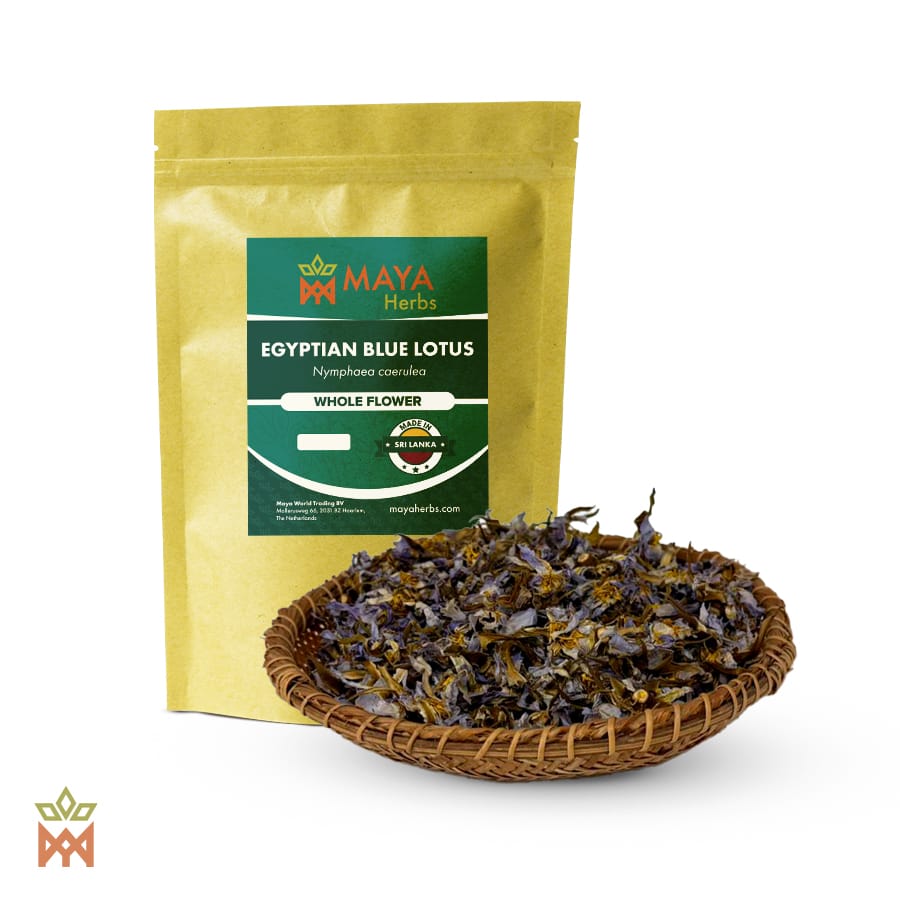
Egyptian blue lotus, Nymphaea Caerulea, is a blue water lily offered by Maya Herbs as whole dried flower. It is valued for its soft floral aroma, peaceful evening presence and gentle mood-opening quality. Many of our customers choose Egyptian blue lotus for tea, meditation, dream practice and quiet moments before rest.
The Egyptian blue lotus effects are usually described as subtle. People often speak of relaxation, a light euphoric tone and a more reflective state of mind. These impressions come from long-standing plant traditions and modern ethnobotanical interest, not from a promise of a fixed effect. Each person may experience the flower differently.
The most appreciated Egyptian blue lotus benefits are simple and ritual-based. It can help create a calm atmosphere, invite the mind to slow down and add beauty to a sensory plant practice. If you are exploring plants with a softer dreaming or evening character, you may also enjoy our Dream Herbs collection.
Research and historical writing have explored Egyptian lotus as a culturally important water lily. Early ethnobotanical work describes the transcultural ritual use of narcotic water lilies, while later phytochemical studies have investigated compounds in Nymphaea caerulea flowers. We share this knowledge with care, because Maya Herbs works with ethnobotanical plants in a way that honours both tradition and responsible use.
Egyptian lotus in ancient symbolism and plant tradition
Egyptian lotus has a long place in the visual and ritual culture of ancient Egypt. It appears in art, temple scenes and symbolic settings, often linked with renewal, the sun, beauty and altered states of ceremony. Although it is commonly called a lotus, it is botanically a water lily.
Academic writers have discussed Nymphaea caerulea in relation to ancient Egyptian ritual contexts, including trance, symbolic journeying and ceremonial plant use. One paper on the narcotic water lily and mandrake in dynastic Egypt reflects this wider scholarly interest. We avoid reducing this plant to a novelty or a strong intoxicant. For Maya Herbs, Egyptian blue lotus flower is best approached as a historic ceremonial plant with a gentle, contemplative character.
In modern herbal and ethnobotanical circles, the flower is often used for relaxation, beauty, sensory ritual and dream-focused practice. The Maya Team loves the whole flowers because they keep the form, colour and presence of the plant visible. This matters to people who connect with herbs not only through effect, but also through scent, texture and ritual.
How to use blue lotus flowers as tea or infusion
If you are wondering how to use blue lotus flowers, the most common preparation is Egyptian blue lotus tea. Whole flowers can be steeped in hot water to make a fragrant, slightly bitter and floral infusion. Start with a modest amount, especially if you are new to this plant.
- Place a small amount of whole Egyptian blue lotus flower in a cup or teapot.
- Add hot water. Avoid aggressive boiling directly on the flowers if you want to preserve the delicate aroma.
- Cover and steep for several minutes, until the infusion has a gentle floral colour and scent.
- Strain, sip slowly and notice how your body responds.
Some people use Egyptian blue lotus tea in the evening, during meditation, with journaling or as part of a quiet sensory ritual. Others combine it with calm breathwork or soft music. Keep the setting simple. This flower works best when approached with patience rather than expectation.
We do not recommend daily heavy use or mixing this plant with alcohol, strong sedatives or other substances. If you are sensitive to herbs, pregnant, breastfeeding, taking medication or unsure whether this plant is right for you, seek qualified guidance before use.
Keeping whole Egyptian blue lotus flower fresh
Store whole Egyptian blue lotus flowers in a cool, dry and dark place. Keep the bag or jar well closed after each use. This helps protect the flower’s aroma, colour and texture.
Avoid moisture, direct sunlight and heat. Dried flowers are delicate. Handle them gently, especially if you want to keep the blooms whole for tea ceremony, display or ritual preparation.
Why buy Egyptian blue lotus from Maya Herbs
People choose to buy Egyptian blue lotus from Maya Herbs because they value careful selection, clear plant information and respectful ethnobotanical context. We are proud to have Nymphaea Caerulea in our catalogue, because it carries a rich history and remains meaningful for many plant lovers today.
This product is whole flower from Sri Lanka. Maya Herbs offers it for those who prefer the full plant part rather than a tincture or extract. Whole flowers invite a slower relationship with the plant. You can see, smell and prepare them yourself.
If you enjoy related water lilies, you may also explore Red Lotus or White Water Lily. For a similar whole-flower option from another origin, Maya Herbs also offers Blue Lotus whole flowers from Thailand.
Further reading on Egyptian blue lotus
- Transcultural use of narcotic water lilies in ancient Egyptian and Maya drug ritual — by WA Emboden, 1981
Discusses the anthropology and ethnobotany of psychoactive plants, including the blue water lily, Nymphaea caerulea.
sciencedirect.com - The sacred journey in dynastic Egypt: shamanistic trance in the context of the narcotic water lily and the mandrake — by W Emboden, 1989
Explores dynastic Egyptian ritual contexts involving the narcotic water lily and mandrake.
tandfonline.com - Blue Nile Flower Rituals from the Perspective of Transpersonal Psychology-The Role of Nuciferine and its Putative Value as an Antipsychotic Drug — by JMK Hesselink, 2018
Discusses a recent neoshamanic ritual based on resin from the Blue Nile Flower, Nymphaea caerulea.
edelweisspublications.com - Ethnobotany and phytochemistry of the sacred blue lily of the Nile, Nymphaea caerulea Savigny, Nymphaeaceae — by M Yoshpa, 2004
Analyzes flower extracts of the ancient Egyptian sacred plant, the Blue Lily of the Nile, using GC/MS, LC/MS and NMR.
search.proquest.com - Some Sedative Plants in Ancient Egypt: Egyptian Blue Lotus, Hemp, Mandrake & Opium Poppy — by VI Shehatta Attia, 2022
Looks at sedative plants in ancient Egypt and their role in historical and folk practice.
real.mtak.hu - Nymphaea cults in ancient Egypt and the New World: a lesson in empirical pharmacology — by E Bertol, V Fineschi, SB Karch…, 2004
Discusses Nymphaea cults in ancient Egypt and the New World in relation to empirical pharmacology.
journals.sagepub.com - Unravelling Egyptian blue Lily (Nymphaea nouchali) organs’ metabolome via UHPLC/PDA/ESI-QTOF-MS and in relation to their antioxidant and anti-cholinesterase — by IY Younis, AF Essa, SA El-Newary, AM Elgamal…, 2025
Investigates the metabolome of Egyptian blue lily organs, including work related to Nymphaea caerulea flower extract.
nature.com
This product is sold as a botanical specimen. Information provided here is for educational and ethnobotanical purposes only. It is not intended to diagnose any ailment, or to treat, cure, or prevent any disease. Please check your local regulations before ordering botanical products.



Reviews
There are no reviews yet.