
Ginkgo leaf extract and its defining compounds
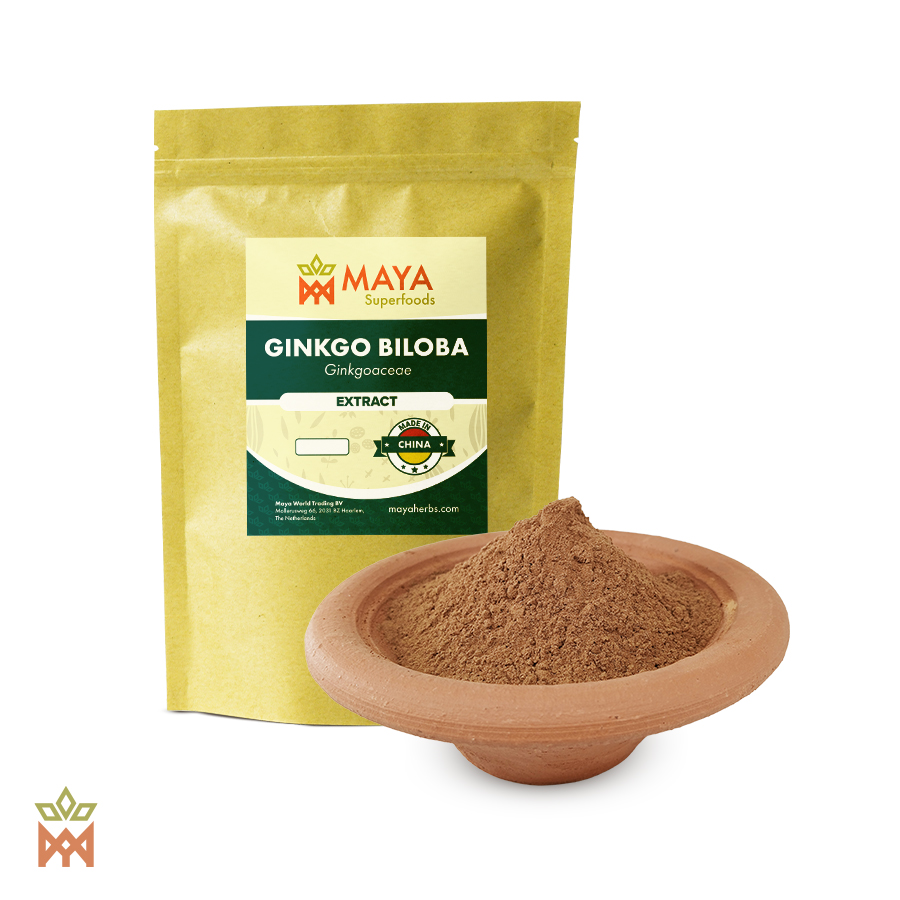
This dry extract is made from Ginkgo biloba leaves harvested in China’s Anhui region. Its stated composition is at least 24% flavone glycosides and 6% terpene lactones, the two groups of constituents commonly used to describe concentrated ginkgo leaf extracts. These figures give a more precise starting point than broad promises about memory or “brain power.”
The source tree is familiar for its fan-shaped leaves and golden autumn colour. In China and Japan it has long been cultivated in temple gardens. Its surviving lineage and long-lived individual trees have made it a symbol of endurance; the preparation sold here belongs to the much more recent history of botanical extraction.
From leaf chemistry to modern extracts
Ginkgo’s chemistry became a particularly engaging research subject in the twentieth century. In 1967, researchers described the structures of ginkgolides A, B and C, bitter constituents isolated from the leaves. Their unusual molecular structures helped make ginkgo distinctive in natural-products chemistry.
Flavone glycosides and terpene lactones are different groups of compounds. The first includes glycosides related to flavonoids such as quercetin and kaempferol; the second includes ginkgolides and bilobalide. The stated 24% and 6% figures refer to constituent content. They are not extraction ratios, and they do not mean that the product is 24 or six times stronger than a leaf powder.
Extraction also differs from simply milling a dried leaf. Our separate Ginkgo leaf powder retains the ground plant material, whereas this product concentrates selected leaf constituents into a dry preparation.
What the clinical studies actually concern
Ginkgo is extensively researched, but study results depend on the preparation and the question being asked. A 24-week trial involving 410 people with mild to moderate dementia and associated neuropsychiatric symptoms found improvements on cognitive and symptom assessments with the defined extract EGb 761 compared with placebo. This was a study in a particular patient group, not a demonstration that any ginkgo product improves everyday concentration.
Prevention is a different question. In the much larger Ginkgo Evaluation of Memory trial, a standardised extract did not prevent dementia over a median follow-up of 6.1 years. Together, these findings explain why ginkgo’s research cannot be reduced to a general promise of better memory.
The European pharmacopoeial specification for refined ginkgo extract also limits ginkgolic acids to no more than 5 parts per million. Matching the headline flavonoid and terpene percentages alone does not establish equivalence to EGb 761 or another medicinal extract. No such equivalence is claimed for this product.
Source and specification
Maya’s supplied specification describes this Anhui extract as batch-tested, without fillers or additives, and free of residual extraction solvents. Its distinguishing details are the leaf origin, dry extract form and declared constituent levels.
Ginkgo may interact with medicines, particularly blood thinners. Seek professional advice before use alongside medication, and during pregnancy or breastfeeding. Instructions intended for ordinary leaf powder should not be transferred to a concentrated extract.
Understanding the preparation makes the botanical story more useful: this is a concentrated Chinese leaf extract, with composition stated separately from the clinical findings on other, specifically tested products.
Selected references
- Royal Botanic Gardens, Kew — Ginkgo biloba: botanical and cultural background
- Chemical Society — Ginkgolides: isolation and structural investigation (1967)
- European Medicines Agency — Ginkgo leaf assessment, constituents and pharmacopoeial limits (PDF)
- Ihl and colleagues — Defined EGb 761 extract in a 24-week randomised trial (2011)
- DeKosky and colleagues — Ginkgo Evaluation of Memory randomised trial (2008)
- European Medicines Agency — Ginkgo leaf monograph: preparation and safety information (PDF)
Information on traditional, cultural and reported uses is provided for educational and ethnobotanical purposes only and does not constitute medical advice. This product is not intended to diagnose, treat, cure or prevent any disease.
Reviews
There are no reviews yet.