
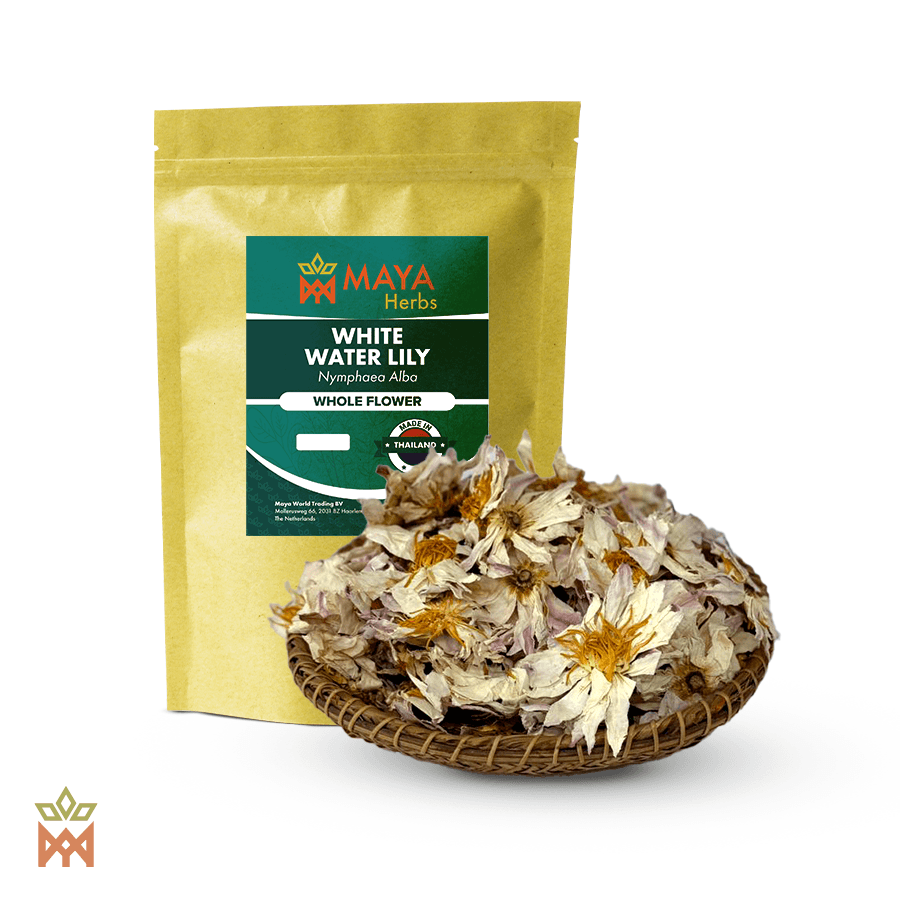

A White Flower with a Calming Herbal Tradition
Nymphaea alba, commonly called White Water Lily, has a long place in herbal traditions associated with cooling, composure and restfulness. The flower’s soft, reflective reputation also appeals to contemporary interest in meditation and quiet evening ritual. Maya Herbs offers whole dried flowers from Sri Lanka.
A Distinct White Water Lily
In the living plant, many white petals surround a golden-yellow centre, with rounded leaves floating across the water. Its rhizomes anchor it in the pond bed while long stalks carry the flowers toward the surface.
White Water Lily is a common name shared by several species. These flowers are Nymphaea alba, a member of the water-lily family, Nymphaeaceae. They are distinct from the separately offered Nymphaea ampla cut flowers from Thailand.
Traditional Use and Reported Character
Older herbal descriptions associate White Water Lily with cooling and astringent qualities. Its flowers appear in records of infusions and external preparations, with a reputation for a soothing, settling character. A 2013 botanical review specifically discusses the flowers’ traditional sedative reputation.
Contemporary ethnobotanical descriptions also refer to relaxation and a lightly euphoric mood. These are descriptions of reported experience and traditional use, rather than a predictable response to the whole flowers.
The flower’s place in reflective plant practice draws on this quieter character. Its own herbal history gives it an identity separate from the Egyptian traditions of Blue Lotus and the Mesoamerican associations of Nymphaea ampla.
Research on the Flowers and Plant
In 2018, researchers examined wild Nymphaea alba from Romania’s Danube Delta, comparing extracts from flowers, fruit, leaves, stems and roots. They identified polyphenols and flavonoids, with flower and fruit extracts showing the highest antioxidant activity in their laboratory tests. This documents the flower’s chemical complexity without establishing a health benefit from these dried flowers.
A 2011 study investigated an ethanolic extract made from the entire plant in mice. The researchers observed changes in exploratory behaviour that they interpreted as reduced anxiety in the experimental tests, alongside effects on motor coordination. This is preclinical research on a whole-plant extract, rather than a test of the flowers sold here.
Keeping the Whole Flowers
Store the flowers in a well-closed container in a cool, dry, dark place. Protect them from moisture, heat and frequent air exposure, and handle gently to preserve their delicate structure.
The Blue Lotus and water-lily collection brings together related species and preparations, each with its own botanical identity and history.
This product is supplied as a botanical specimen. Information is for educational and ethnobotanical purposes and is not intended to diagnose, treat, cure or prevent disease.
Selected References
- Royal Botanic Gardens, Kew — Nymphaea alba botanical identity.
- Lakshmi et al. (2013) — overview of White Water Lily and its traditional herbal use.
- Cudalbeanu et al. (2018) — comparative analysis of plant parts, including flower extracts, from the Danube Delta.
- Thippeswamy et al. (2011) — behavioural research using a whole-plant ethanolic extract in mice.
Reviews
There are no reviews yet.