

Silver-backed leaves and a wooden rose
Large heart-shaped leaves, soft silver hairs beneath them and pale purple flowers give Hawaiian Baby Woodrose a distinctive appearance. As the fruit develops, the persistent sepals form the rose-like structure behind its common name.
From Asia to Réunion
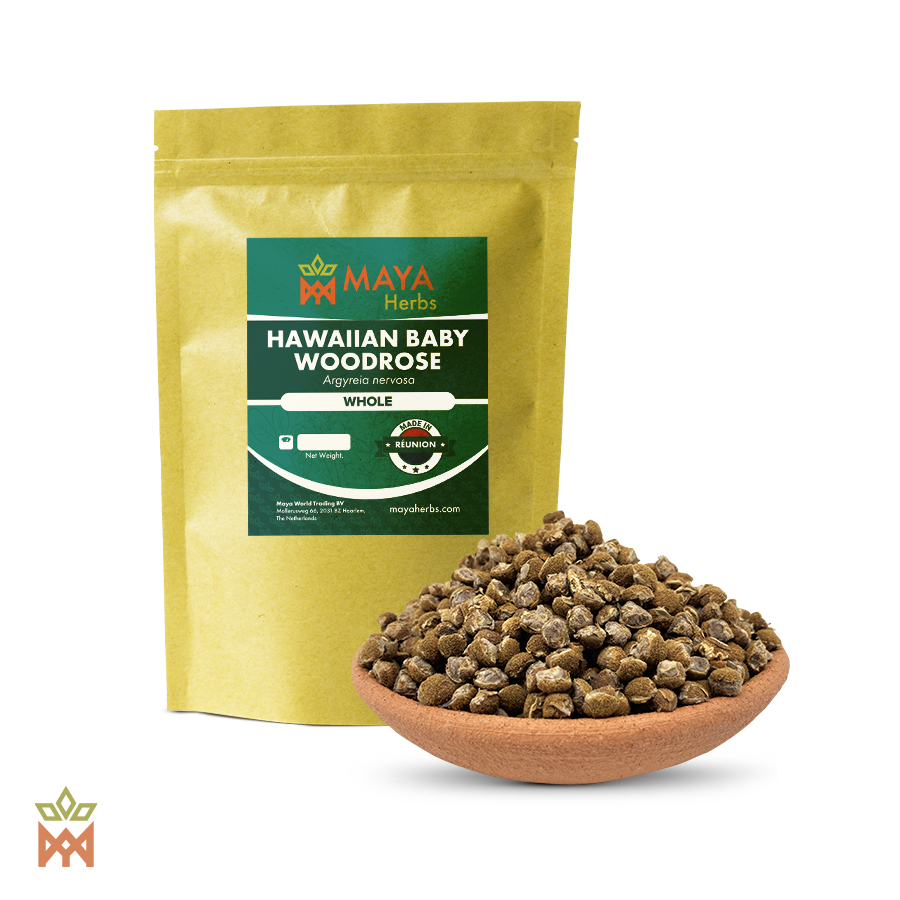
The seeds offered here are wild-harvested on Réunion, a French volcanic island in the Indian Ocean, east of Madagascar and southwest of Mauritius. This tropical island is one of the places where Argyreia nervosa has become established beyond its native Asian range.
Despite the familiar name Hawaiian Baby Woodrose, the species originates from the Indian subcontinent to Myanmar. It was introduced to Hawaii, where it is cultivated and has also become naturalised. The Hawaiian name is therefore an association with a place where the vine grows, rather than an indication of its native origin.
The older botanical name Argyreia speciosa also appears in literature. The plant is recognisable by its broad leaves with densely hairy undersides and clustered, funnel-shaped flowers. Its substantial perennial growth gives it a different character from the familiar annual Ipomoea tricolor.
Traditional background and modern seed research
Argyreia nervosa has a place in Indian traditional medicine, where records concern several plant parts, including roots and leaves. That wider history needs to be distinguished from the more recent scientific interest in the seed’s ergot alkaloids.
By the 1960s, published investigations were examining these seeds and their psychoactive constituents. The plant’s Indian traditional background and the modern investigation of its seeds are distinct parts of its history. Accounts about roots or leaves do not establish ceremonial practices involving the seeds.
What analysis of the seeds shows
Studies have identified ergine, also called lysergic acid amide or LSA, together with related alkaloids such as isoergine. Analyses of commercial samples have found substantial variation in composition. A species name or island origin therefore cannot establish a fixed concentration or predictable effect for an individual seed lot.
The Dutch National Institute for Public Health and the Environment reviewed seed analyses, human reports and toxicological evidence in its assessment of A. nervosa. It concluded that ingestion poses a safety concern and could not establish a safe intake level. Reported adverse effects include nausea, vomiting, raised heart rate and blood pressure, and psychological disturbances.
The interest of these seeds lies in the distinctive vine they represent and its documented botanical history. No alkaloid assay or germination percentage is specified for this lot.
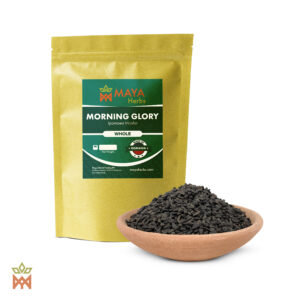
Explore related species in our Morning Glory collection.
Selected references
- Royal Botanic Gardens — Plants of the World Online: Argyreia nervosa, native range and synonyms
- Hylin and Watson (1965), Ergoline Alkaloids in Tropical Wood Roses — primary research abstract
- RIVM, Dutch National Institute for Public Health and the Environment — Risk assessment of Argyreia nervosa (2020)
- French Ministry for Overseas Territories — Réunion
This product is sold as a botanical specimen. Information on traditional, cultural and reported uses is provided for educational and ethnobotanical purposes only and is not a recommendation for any particular use. This product is not intended to diagnose, treat, cure or prevent any disease.
Reviews
There are no reviews yet.