
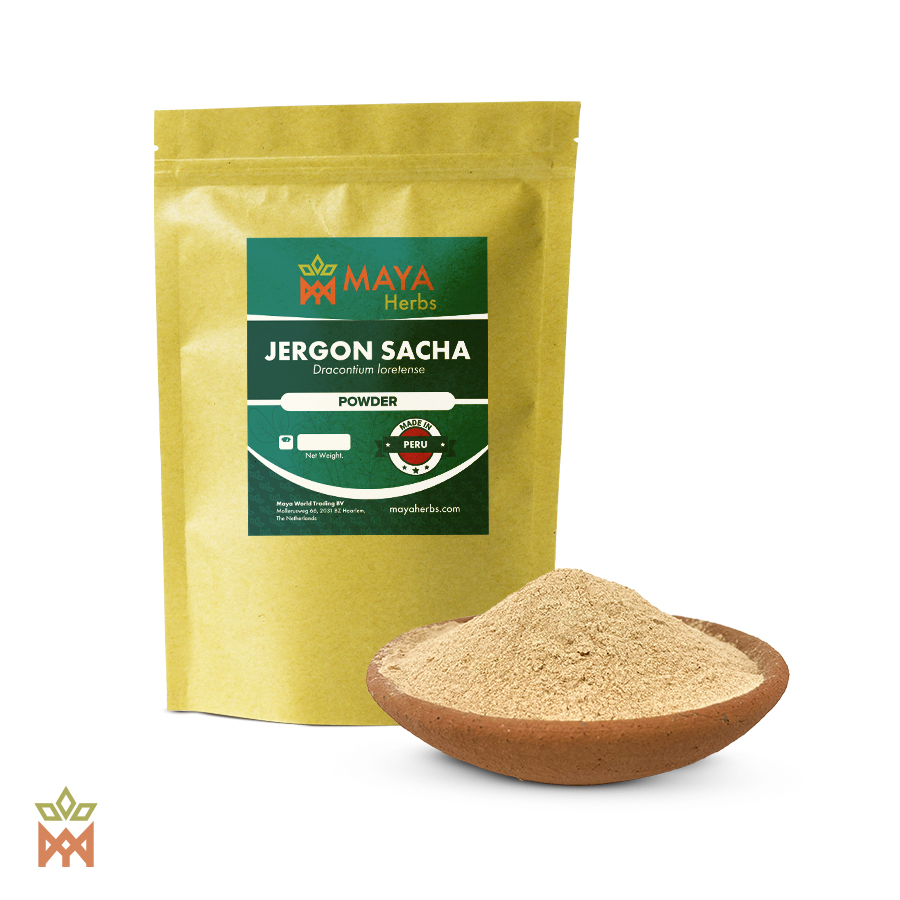




Jergon Sacha, the plant with a snake-patterned stalk
Jergon Sacha is a striking plant of the humid forest floor. Its long, mottled leaf stalk resembles the patterned skin of the jergón snake, giving the plant a name that links botanical observation with Amazonian cultural history. Maya offers this Peruvian material as a pure, organic powder, without additives or fillers.
A forest plant with two familiar scientific names
The accepted botanical name is Dracontium spruceanum; Dracontium loretense, still widely used in Peruvian ethnobotanical literature, is a synonym. It belongs to Araceae, the arum family. Above ground, the finely divided leaf spreads from a tall stalk; below ground, the plant stores resources in a corm, a thickened underground stem.
Peru’s Amazonian research institute records it in shaded primary and secondary forest, including areas around Iquitos and tributaries of the Amazon. The same account lists names in several Indigenous languages, among them ronon rao in Shipibo-Konibo. This is a plant recognised across distinct communities, each with its own language and knowledge.
Spiritual protection in healer training
Jergon Sacha has a documented place in Amazonian shamanic practice. Fieldwork conducted in the Ucayali region between 2003 and 2008 recorded it among the plantas con madre, plants understood to have a spiritual “mother”. Participants included Shipibo-Konibo and mestizo healers, alongside other practitioners. In their accounts, such plants could become allies during a healer’s apprenticeship.
The researchers placed Jergon Sacha in the group associated with protection and defence. Its preparation was recorded as a decoction within the wider discipline of plant dietas. These periods involved restrictions and learning under an experienced healer; the relationship with a plant’s mother was understood as something developed through that process. Protection referred to the practitioners’ spiritual world, including harmful influences and encounters described in dreams. It is an account of a living belief system, rather than an effect promised by a bag of powder.
What has been studied in the corm
A 2009 chemical study isolated four previously undescribed oxylipins from D. loretense corms. Oxylipins are molecules derived from fatty acids. One of the isolated compounds increased the proliferation of human immune cells in a laboratory experiment.
That finding is specific to a separated compound tested on cells. It does not demonstrate that Jergon Sacha powder improves immunity in people. It does, however, show why the underground part has attracted scientific interest alongside the plant’s unusually well-documented cultural significance.
Jergon Sacha’s protective reputation also includes historical associations with snakebite. It is not an antivenom; snakebite requires urgent medical treatment. For another perspective on medicinal trees and their spiritual “mothers” in Peru, see our account of Murure and Kukama-Kukamiria plant knowledge.
Selected references
- Royal Botanic Gardens, Kew — Dracontium spruceanum and the synonym D. loretense
- Instituto de Investigaciones de la Amazonía Peruana — Jergon Sacha: habitat, names and underground parts
- Jauregui and colleagues (2011) — plantas con madre and shamanic apprenticeship in the Peruvian Amazon
- Benavides and colleagues (2009) — oxylipins isolated from Dracontium loretense corms
- Lovera and colleagues (2006) — experimental research prompted by traditional snakebite associations
This product is sold as a botanical specimen. Information on traditional, cultural and reported uses is provided for educational and ethnobotanical purposes only and is not a recommendation for any particular use. This product is not intended to diagnose, treat, cure or prevent any disease.
Reviews
There are no reviews yet.