


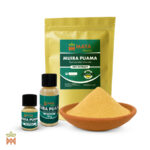
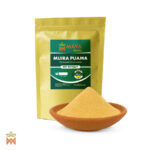
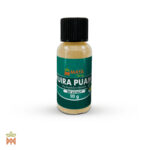

Concentrated Muira Puama from Brazil
This dry extract is prepared from the bark and roots of Ptychopetalum olacoides, the Brazilian forest tree known as Muira Puama or marapuama. Muira Puama’s traditional tonic reputation has prompted investigations into the activity of root extracts and the composition of commercial preparations.
Roots, bark and herbal history
Muira Puama grows naturally in northern Brazil and the Guianas. Roots and bark both appear in the records of local herbal practice, including its use as a tonic. The familiar name “potency wood” reflects its aphrodisiac reputation, but ethnopharmacological research has also followed a different strand of the tradition: the use of root preparations as nerve tonics.
What researchers have found in extracts
A 2010 study compared Muira Puama stem bark with three commercial extracts. Researchers identified vanillic acid, protocatechuic acid and theobromine, then developed a chromatographic method using vanillic acid as a marker. Chromatography separates constituents in a sample so that a selected substance can be identified and measured.
The marker provides a practical reference for quality analysis. It does not mean that vanillic acid alone accounts for Muira Puama’s traditional reputation: a botanical extract contains a mixture of constituents, and their proportions depend on the starting material and extraction process.
Root-extract research has also examined acetylcholinesterase, an enzyme involved in nerve signalling. In a 2003 experiment, an ethanol extract inhibited this enzyme in laboratory tissue tests and in aged mice. This is a possible mechanism for further investigation, rather than evidence of a cognitive benefit from this commercial dry extract.
Research on the dried preparation
In 2020, a Brazilian team used authenticated roots collected in Amapá to investigate the production of dried Muira Puama extracts. They studied spray drying and compared formulations with and without a processing aid, measuring moisture, particle characteristics and flavonoid content.
The work shows how drying conditions can influence the physical and chemical characteristics of an extract. It describes experimental formulations; the processing aid used in some of those samples is not an ingredient statement for this product.
Our Muira Puama is wild-harvested in Brazil through partners using sustainable harvesting practices. The dry extract is supplied without fillers or additives, retaining the stated bark-and-root composition in a concentrated preparation. It sits alongside the Muira Puama powder in the wider Well-being collection.
Selected references
- Colombo and colleagues (2010) — Chemical markers and analysis of commercial Muira Puama extracts
- Trindade and colleagues (2020) — Laboratory preparation and characterisation of dried Muira Puama extracts
- Siqueira and colleagues (2003) — Preclinical investigation of acetylcholinesterase activity
- Grenand and colleagues (2004) — Traditional pharmacopoeias of French Guiana
This product is sold as a botanical specimen. Information on traditional, cultural and reported uses is provided for educational and ethnobotanical purposes only and is not a recommendation for any particular use. This product is not intended to diagnose, treat, cure or prevent any disease.


Reviews
There are no reviews yet.