


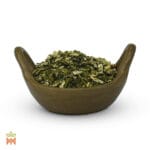

An earthy tea with a South American history
Yerba mate is one of South America’s most familiar leaf teas, with an earthy, herbal flavour and a characteristic bitter edge. It comes from Ilex paraguariensis, an evergreen member of the holly family known in Brazil as erva-mate. Naturally caffeinated and full of character, it has a place in daily life across Brazil, Paraguay, Argentina and Uruguay.
Our cut leaves come directly from Brazilian farmers who grow the plant on sustainable plantations using traditional farming practices.
The plant behind the tea
Yerba mate grows as a shrub or tree, with dark green leaves, finely toothed edges, small greenish-white flowers and red fruits. Its native range includes parts of Brazil, Paraguay, Uruguay and northeastern Argentina. Although commonly called a tea, it belongs to a different plant family from the Camellia sinensis used for black and green tea. The dried leaves are the part that gives mate its distinctive flavour.
Mate in South American life
The history of mate is closely connected with Guaraní peoples, whose knowledge of the plant preceded its spread through colonial South America. Over time, the drink became part of everyday hospitality across the region. A shared mate is still a familiar companion to conversation, with the vessel refilled and passed from one person to the next.
In southern Brazil, hot mate is known as chimarrão. Its traditional vessel is the cuia, a hollowed gourd, and the filtered metal straw is called a bomba, or bombilla in Spanish. Paraguay is particularly associated with tereré, the cold preparation also enjoyed in parts of Brazil. In 2020, UNESCO recognised the practices and traditional knowledge surrounding Paraguayan tereré in the culture of Pohã Ñana, including the knowledge of herbs added to its water. The recognition celebrates a living tradition of sharing and passing on knowledge within families.
Natural caffeine and leaf compounds
Yerba mate naturally contains caffeine and the related compound theobromine. Its leaves also contain polyphenols, including chlorogenic acids, which have been identified in studies of mate infusions. The amount extracted changes with the quantity of leaf, the water and the brewing method. A lightly brewed cup and a gourd refilled several times can therefore provide quite different amounts of caffeine.
Yerba mate tea in a cup or teapot
For a simple cup, place 1–2 teaspoons of cut leaves in a tea infuser or teapot and add about 250 ml of water at 70–80°C. Steep for 3–5 minutes, then strain. Start with the smaller quantity for a lighter brew and adjust to taste. The tea can be enjoyed plain, with a little honey or with a slice of lemon.
Traditional hot yerba mate
For the traditional method, use a gourd or mate cup with a filtered bombilla. Fill the vessel about two-thirds full with leaves, cover the opening and tilt it so the leaves gather on one side. Add a small amount of lukewarm water to the lower side and let it soak in before placing the bombilla in that space.
Pour small amounts of hot water at 70–80°C beside the straw, leaving the upper part of the leaf mound dry at first. Keep the straw in place and refill as the flavour develops through successive pours. Allow each infusion to cool to a comfortable drinking temperature before sipping.
Tereré with mint and citrus
For a cold preparation, half-fill a cup or guampa with yerba mate and place the bombilla among the leaves. In a separate jug, combine cold drinking water and ice; a few fresh mint leaves and slices of lemon or orange make a refreshing addition. Pour the chilled water over the mate, allow it to settle, then sip and refill as desired. Tereré is prepared with cold water from the start.
Keep the dry leaves tightly closed, away from moisture, heat and direct sunlight.
Selected references
- Oregon State University — Ilex paraguariensis: botany and leaf constituents
- Argentina’s National Institute of Yerba Mate — the history of mate
- UNESCO — Paraguayan tereré traditions, inscribed in 2020
- Research on the composition of yerba mate under different brewing conditions (2024)
- Research on chlorogenic acids in prepared mate infusions (2017)
- National Institute of Yerba Mate — traditional hot preparation
- National Institute of Yerba Mate — tereré preparation
Reviews
There are no reviews yet.