

Embauba and the life of the tropical forest
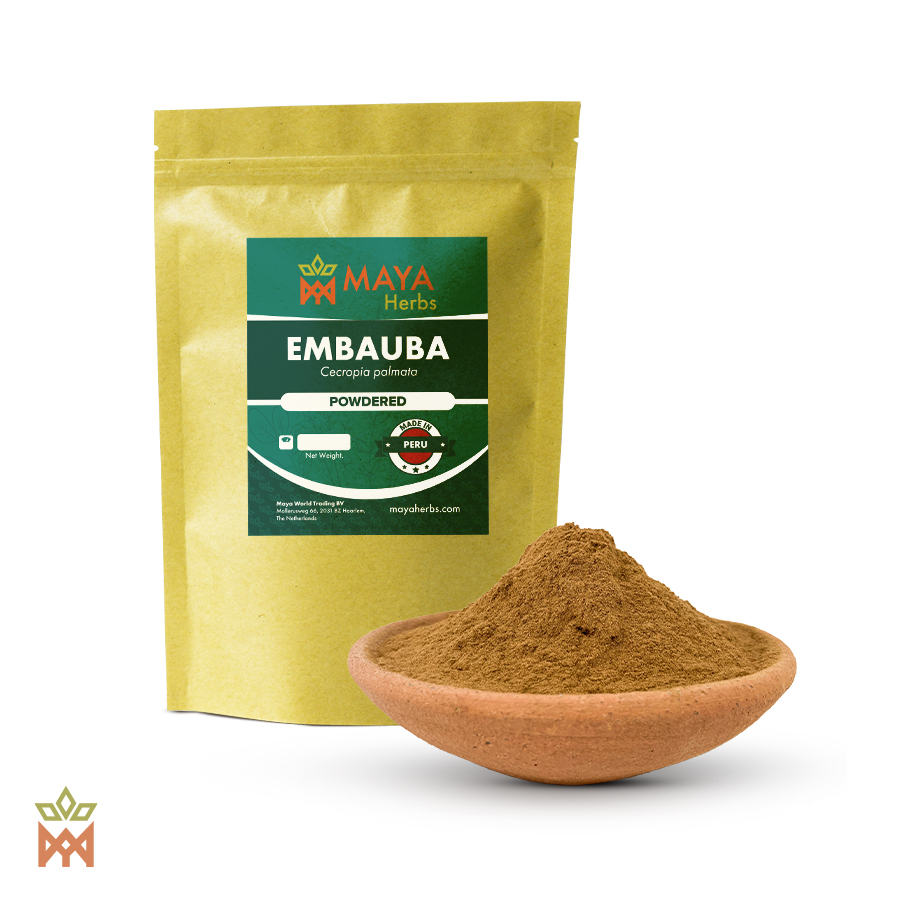
The large, hand-shaped leaves of Embauba are a recognisable feature of tropical American forests. Cecropia palmata belongs to a group of fast-growing trees whose lives are closely connected with the insects and animals around them. Its leaves also have a place in regional herbal knowledge. Maya offers powdered leaf from Peru, sustainably harvested through work with local communities.
The tree behind the leaf
Cecropia palmata is a member of the nettle family, Urticaceae. Its native range extends across northern South America into northeastern Bolivia and includes Peru. Embauba is a name shared by several Cecropia species; this one is also described in Brazilian botanical research as white Embauba.
Its relationship with ants provides a particularly vivid detail of its forest ecology. Research in French Guiana has examined ants associated with C. palmata and the closely related C. obtusa. Microscopic examination revealed fine hairs on the undersides of their leaves, a surface that influences how ants grip and hunt. Such details show how even a leaf’s texture participates in the life around the tree.
Leaves in regional herbal practice
Brazilian ethnobotanical records list C. palmata under names including imbaúba and torém. A survey of northeastern Brazilian plant traditions describes leaf infusions valued as a tonic and for their perceived stimulating and diuretic qualities. These are historical and regional descriptions of why people prepared the leaves, rather than established effects of the powder sold here.
The relevant preparation in that record is an infusion of the leaf. This gives a concrete context for Embauba as a botanical material, while the species name helps keep its story distinct from those of other trees sold under the same common name.
Research on Cecropia palmata leaves
A Brazilian study published in 2017 examined identified C. palmata leaves collected over three years. Researchers compared water infusions with preparations made using other extraction solvents and analysed their phenolic constituents. Catechin and caffeic acid were among the compounds investigated in the species.
The work matters because it treats the leaf as a complex, variable material: what researchers detect depends partly on how a sample is prepared and when it was collected. It is a chemical study, rather than a demonstration of a clinical benefit from drinking an infusion or using leaf powder.
Keep the powdered leaves tightly closed in a dry place away from sunlight. Embauba forms part of our Well-being collection, where its botanical identity, regional history and forest ecology can be considered together.
Selected references
- Royal Botanic Gardens — Cecropia palmata: identity and distribution, including Peru
- Dejean and colleagues (2010) — ant behaviour and Cecropia leaf surfaces
- Agra and colleagues (2008) — regional records of Cecropia palmata leaf infusions
- Pires and colleagues (2017) — phenolic analysis of identified Cecropia palmata leaves
This product is sold as a botanical specimen. Information on traditional, cultural and reported uses is provided for educational and ethnobotanical purposes only and is not a recommendation for any particular use. This product is not intended to diagnose, treat, cure or prevent any disease.

Reviews
There are no reviews yet.